Roller doors are a commonly used solution for industrial buildings due to their compact design and fast operation. However, many companies find that traditional roller doors are very noisy during use. In some situations, this can cause nuisance for employees or create an unpleasant working environment. In this article, we explain why roller doors can be noisy, what noise standards exist and what the advantages are of a quieter alternative.
Why do roller doors make a lot of noise?
Traditional roller doors consist of slats that move up and down via a roller mechanism. The noise is caused by several factors:
- Roller mechanism and bearings: in older or poorly maintained doors, bearings can start to squeak or grind.
- Contact between the slats and side guides: friction between the slats and side guides often causes an audible noise.
- Wind or air pressure differences: large doors that are open can flap or vibrate, which creates additional noise.
In short: the mechanical system and interaction with the environment are the main causes of noise in traditional roller doors.
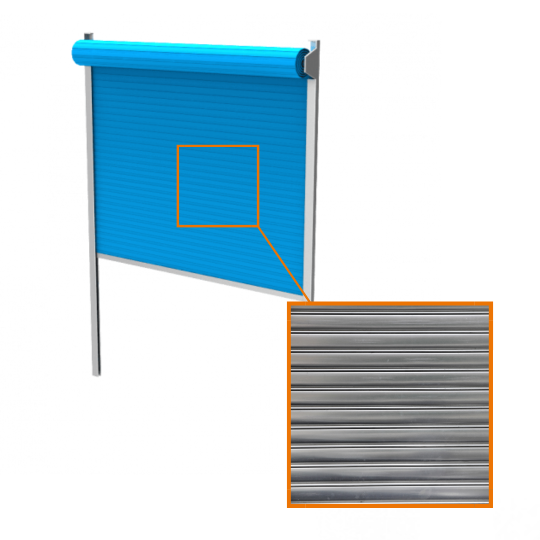
The slats of a roller door
What are the noise standards or guidelines for doors in industrial buildings?
There are no strict legal noise limits for doors in industrial buildings, but there are recommendations and guidelines to keep noise levels at a comfortable level for working. However, these noise standards are obligations for both employees and employers. Employers in the UK must:
- When exposed to a daily dose above 80 dB(A), employers must provide hearing protection. Employees are obliged to wear this protection at levels above 85 dB(A).
- Lower level of action
- At a dose of 85 dB(A), employers must take measures to limit noise exposure, which may also lead to the replacement of a noisy roller door.
- Higher level of action
- If the limit value of 87 dB(A) is exceeded, the noise must be reduced immediately to below the limit value. (This is measured in the ear, taking hearing protection into account.)
- Limit value
Source: UK Government
What are the advantages of a quiet alternative in an industrial building?
In addition to creating a more pleasant working environment, a quiet alternative to an industrial door has several advantages. The following are some of the advantages of a quiet soundproof door:
Protection of (potentially) sensitive processes
In halls where precision work or noise-sensitive equipment is present, a silent door prevents vibrations or noise pollution.
Safety
Clearly audible doors can sometimes cause startle reactions; silent doors function smoothly and without disturbance.
Productivity
Less noise pollution allows employees to focus better on their work. This is particularly important in environments with forklift trucks, precision machinery or where employees need to pay close attention due to working with hazardous substances.
The Compact door, a silent alternative.
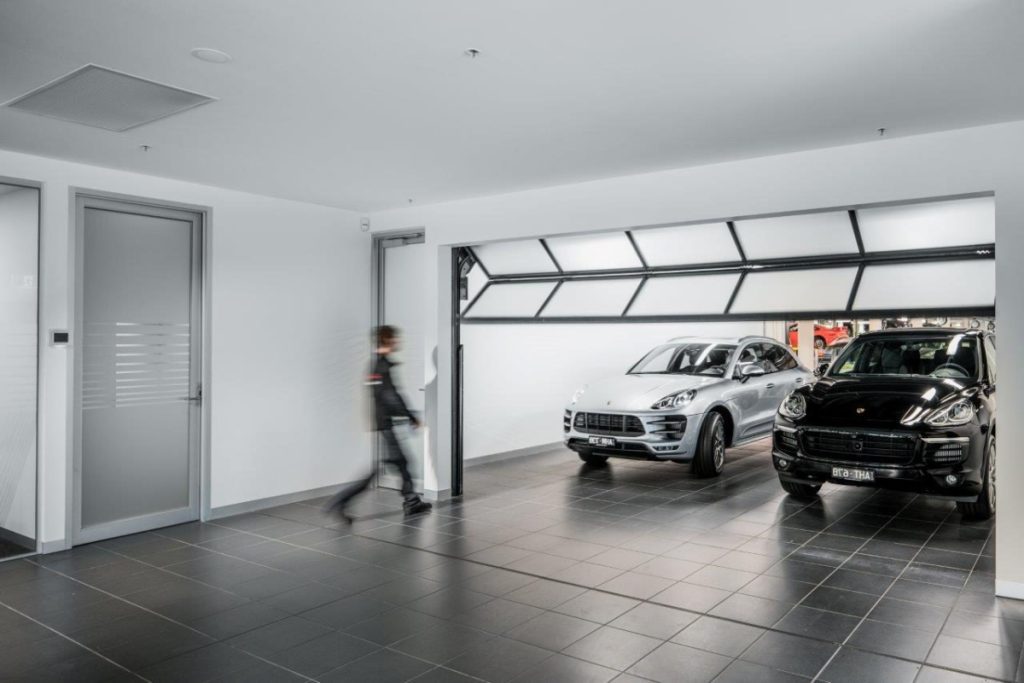
When a traditional roller door is too loud or disruptive, the Compact door from Rolflex offers an excellent solution. A Compact door is just as space-saving as a roller door, with several additional advantages!
What is the Compact door?
The Rolflex Compact door is a folding door in which panels fold up above the doorway. The door is a quieter alternative because the system works with panels rather than slats.
Advantages of the Compact door
- No ceiling rails required (as with a roller door!)
- Low noise
- Easy to maintain (thanks to a system without torsion or balance springs)
- Option of an integrated wicket door
- Option of transparent panels in a space-saving design
Traditional roller doors are practical and space-saving, but can produce a lot of noise in industrial buildings, which reduces working comfort and can affect safety or productivity. Although there are no specific legal noise standards for doors, the general Health and Safety Act guidelines apply to maximum noise exposure for employees.
A quiet alternative therefore offers considerable advantages: it protects sensitive processes, increases safety, promotes productivity and is easier to maintain. The Compact door from Rolflex is an ideal example of such a solution: thanks to its innovative folding system, this door opens and closes quietly and smoothly, saves space and retains all the advantages of a sectional door.
In short: for industrial buildings where noise pollution is a problem, a quiet door such as the Compact door offers an efficient, comfortable and sustainable solution.