When choosing or replacing a commercial door, it is not just the dimensions of the doorway that matter, but also the space around it. Sectional doors require specific installation dimensions: headroom, side clearance and installation depth. If this space is not available, installation can be more difficult — or sometimes even impossible.
In this knowledge article, we explain how much space sectional doors require, how roof shape and ceiling height influence this, and what the options are when the available space is limited.
What are the standard installation dimensions for sectional doors?
Although exact measurements vary by manufacturer, sectional doors typically require the following:
1. Headroom (height above the opening)
This is usually between 115 and 510 mm, depending on:
- The type of rail system (horizontal, low, high, sloping roof-following)
- The presence of torsion springs
- The motor position
2. Side space (left and right of the opening)
The rails and fixings usually require 90 mm per side.
This may be more for larger doors or special motors.
3. Installation depth (space inside the building)
The door leaf slides horizontally into the building.
Therefore, the installation depth must be at least the height of the door, plus extra space for the rails and motor.
In practical terms, this means:
A door that is 3 metres high also requires approximately 3 to 3.5 metres of free depth inside.
What influence do ceiling height and roof shape have?
Ceiling height and roof shape play a major role in determining the rail system.
Ceiling too low?
Then the door must be installed with a low rail system. However, this often limits the positioning of lighting, ventilation and pipes.
Sloping roof?
In that case, a roof-following rail system is often chosen. This is often an additional cost option. Only possible if the door is not positioned directly under the ridge of the gable roof.
High halls?
Then a high or vertical rail system is used. This requires more headroom, and the motor is often mounted much higher.
Obstacles such as pipes, taps, or cable ducts?
Sectional doors may conflict with existing installations, requiring modification.
What happens if the available space is too limited?
If there is insufficient space for the rail system or torsion spring mechanism, the following problems may arise:
1. Relocation of installations
Ventilation ducts, lighting, sprinklers, or cable ducts must be rerouted.
This is often expensive and time-consuming.
2. Customised constructions
Special low rails, shortened springs or modified motor housings may be required — usually at an additional cost.
3. Restrictions on use
A door that just fits sometimes has:
- Limited opening height
- A higher risk of wear and tear
- A higher maintenance frequency
4. Sometimes the door simply does not fit
In renovations or warehouses with many installations, it often happens that a sectional door is not technically feasible.
What alternatives are there when there is insufficient headroom?
When the headroom or installation depth is limited, systems are often sought where the door does not need to slide inwards or require ceiling rails. A roller door may then be chosen, but roller doors often have lower insulation values or do not offer the practical option of an integrated wicket door.
Another alternative is the Compact door, because it:
- No ceiling rails are used
- No torsion springs are required
- The door leaf folds above the opening
- Minimal installation depth is required
- Does not obstruct installations such as lighting or taps
This makes the Compact door suitable for situations in which:
- Existing installations may not be moved
- Renovation takes place in a narrow opening
- Architects want a clean, rail-free ceiling
- Internal logistics (forklift trucks, conveyor belts) must not be obstructed
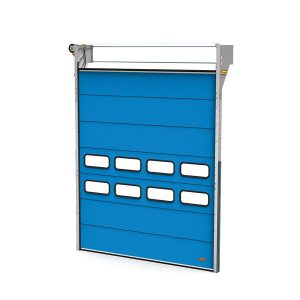
Compact door
Summary
Sectional doors require specific installation dimensions: headroom, side clearance and depth.
If this space is not available — due to ceiling height, roof shape or existing installations — installation can be more difficult or even impossible.
In situations with limited headroom or a lot of technical equipment in the ceiling, an alternative without rails, such as the Compact door, can be a practical and maintenance-friendly solution.