Daylight (and artificial light) plays an important role in workspaces, showrooms and production environments. Light not only creates a pleasant working environment, but also contributes to appearance, safety and energy efficiency. However, we see that traditional sectional doors often unintentionally cause shadows and unwanted light loss in many situations.
What alternatives are there if a sectional door blocks the light? And what should you pay attention to?
Why do sectional doors often cast shadows in workspaces or showrooms?
A sectional door consists of several panels that slide inwards along rails attached to the ceiling. It is precisely this construction that causes problems with light incidence in many buildings.
Common causes of shadowing and light loss:
- Ceiling rails block light
Rails, motors and torsion springs take up space on the ceiling, precisely where lighting or light incidence is often desired.
- Sandwich panels move along the ceiling
Although sectional doors can contain glazing, they often still block lighting that may be located along the ceiling. Even the transparent panels of a sectional door still have an impact on the artificial lighting inside a building.
In showrooms, this can even be detrimental to the presentation of products. In workspaces, it affects comfort and visibility during daily activities.
Which door keeps the ceiling clear and lets daylight through?
If you want to avoid shadows, doors without ceiling rails are the obvious choice. This gives you design freedom and ensures that light and lighting can be used to their full potential.
The most obvious choice in terms of compactness in this case is a roller door. This is because a roller door:
- Compact is
- Relatively inexpensive is
However, there are also disadvantages to roller doors, including in terms of light incidence. Roller doors also have the following characteristics:
- No option for transparent panels. Because a roller door consists of slats, transparent panels are not possible.
- Because a roller door consists of slats, it blocks out almost all natural daylight when closed.
De Compact deur als alternatief
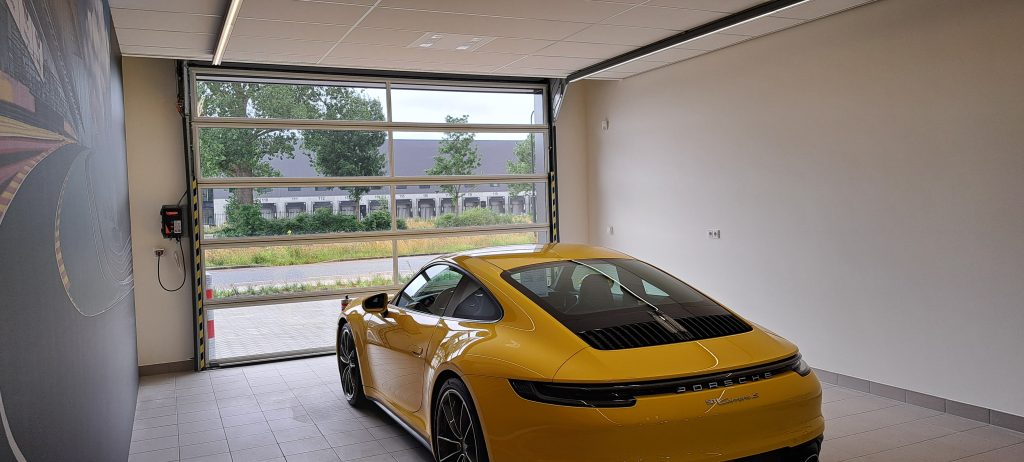
In situations where a sectional door or roller door blocks too much light, Rolflex’s Compact door is often the preferred choice.
The Compact door is constructed from sandwich panels that fold compactly above the doorway, without ceiling rails. This leaves the ceiling completely free for lighting, installations and daylight. Because the Compact door consists of sandwich panels, it also offers the possibility of fully transparent panels and even the option of an integrated wicket door.
What this means in practice:
- No shadows cast by rails or motors
- Optimal lighting
- Option of transparent panels for extra daylight
- A sleek and calm appearance, ideal for showrooms and representative spaces
The Compact door combines the appearance and insulation of a sectional door with the space required to allow light and design to come into their own.
In summary
If a sectional door causes too much shadow or light loss, it is worth looking beyond traditional solutions. By choosing a door without ceiling rails, with attention to light incidence and appearance, the space remains functional and pleasant to work in.