Torsion springs are an essential component of virtually every traditional sectional door. But anyone who works with them knows that they require maintenance. Regular maintenance. Why is that? And what does it mean for your company or project?
In this knowledge article, we explain what torsion springs do, why they wear out, and what consequences this has for the installation, maintenance and use of sectional doors.
What exactly do torsion springs do in a sectional door?
Torsion springs ensure that a sectional door remains balanced. The door leaf of a sectional door is quite heavy. Without support, it would be almost impossible to lift. And opening the door electrically would require a much heavier motor.
The torsion springs:
- Support the weight of the door
- Ensure that the door opens and closes smoothly
- Prevent the door from falling down uncontrollably
- Apply pressure to the system to keep everything in balance
They operate by literally being ‘under tension’. But that tension… is precisely the reason why they require maintenance.
What factors cause wear and tear on torsion springs?
1. High mechanical load during each cycle
Every time a sectional door opens or closes, the spring is tensioned and then released again.
After thousands of cycles, metal fatigue sets in — this is inevitable.
2. Environmental factors
Factors that accelerate wear and tear are present in production halls, workshops, and logistics environments:
- Moisture
- Temperature fluctuations
- Dust and dirt
- Corrosion
The harsher the environment, the faster the torsion spring wears out.
3. Incorrect adjustment or imbalance
If the door leaf is not perfectly balanced, the torsion springs have to work harder than intended.
This causes:
- Uneven wear
- Uneven tension
- Shorter service life
4. Intensive use
Sectional doors that open and close dozens of times a day (e.g. in distribution centres) are more likely to experience:
- Slack springs
- Broken springs
- Malfunctions in the lift system
Regular maintenance is essential — and often underestimated
Because torsion springs are under high tension, maintenance is:
- Specialised
- Labour-intensive
- Often more expensive than users expect
Why is this relevant when choosing a commercial door?
In new construction, renovation or high-use projects, the maintenance of torsion springs can be a factor to consider when choosing a door type.
Architects, contractors and end users increasingly want systems with lower maintenance risks.
Maintenance-friendly alternatives are particularly advantageous in sleek, modern environments or places where reliability is important.
An alternative without torsion springs: the Compact door
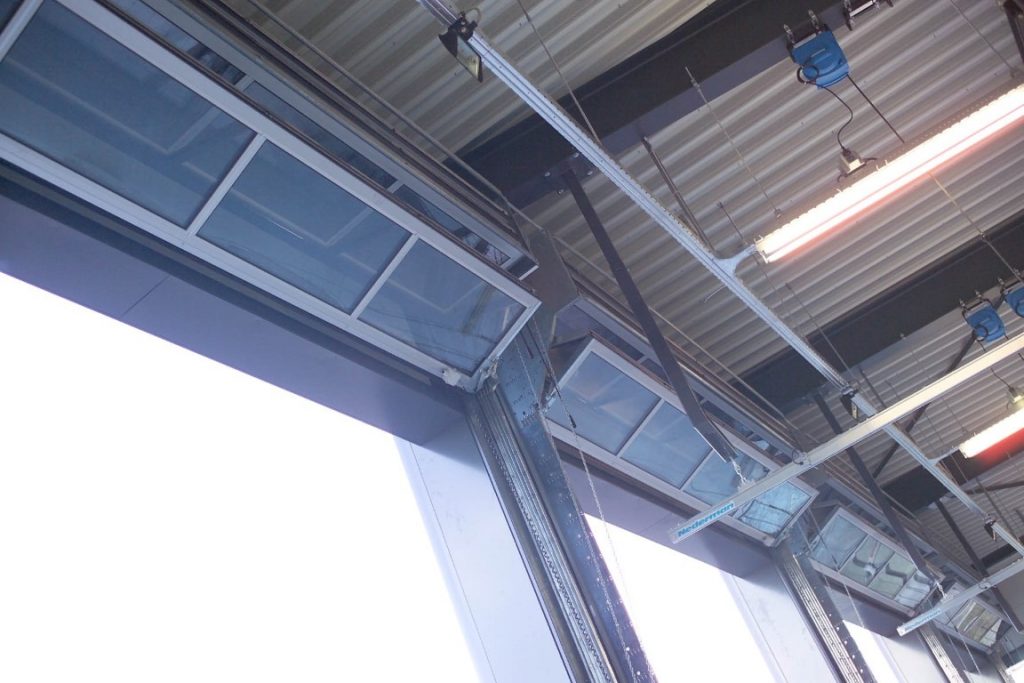
Sectional doors operate with torsion springs because they use rails along the ceiling.
The Compact door operates differently: the door leaf folds itself up, without top rails and without torsion springs.
What that means:
- Fewer maintenance-sensitive parts
- No wear due to tension
- No spring adjustment
- Lower risk of malfunctions
- Quieter, cleaner operation
This makes the Compact door a solution for situations in which:
- Maintenance costs must remain low
- Business continuity is important
Summary
Torsion springs require maintenance because they:
- Under constant stress
- Wear out due to use and environmental factors
- Require specialist maintenance
- Quickly cause problems if incorrectly adjusted
For many users, a sectional door works perfectly well – but in situations where reliability, space or maintenance play a greater role, a door without torsion springs, such as the Compact door, can offer additional advantages.