When choosing an industrial or commercial door, many building owners ask the same question: are sectional doors more expensive than roller doors? Both door types are widely used in warehouses, workshops, logistics centres and industrial buildings. However, they differ significantly in cost, insulation, maintenance and design flexibility.
In this article, we compare sectional doors and roller doors, explain what drives the price difference, and help you decide which option offers the best value for your application.
Sectional doors vs roller doors: what’s the difference?
A sectional door is made up of horizontal insulated panels that move upwards along ceiling tracks. When fully open, the door is stored under the ceiling.
A roller door (or roller shutter door) consists of narrow slats that roll up around a drum above the opening. Roller doors typically do not require ceiling tracks, making them more compact in some situations.
Both systems have advantages, but their cost structure is quite different.
Are sectional doors more expensive upfront?
In many cases, yes — sectional doors often have a higher initial purchase price than standard roller doors. A typical industrial door costs between €2,000 and €6,000, depending on size, insulation and automation. Basic roller doors can sometimes start at a lower price point, especially for uninsulated versions.
However, price comparisons become more complex when you look at insulation, durability and long-term costs.
Roller doors can become more expensive when insulated
Many people assume roller doors are always cheaper, but that is not always true.
Standard roller shutters offer limited insulation. If your building requires temperature control, an insulated roller door is often necessary — and those versions can become significantly more expensive.
Insulated roller doors are:
- Heavier
- Mechanically more complex
- More costly to manufacture
- Sometimes noisier during operation
In fact, an insulated roller shutter can approach or even exceed the cost of an insulated sectional door.
Key differences that affect total cost
1. Insulation performance
Sectional doors typically offer better thermal insulation thanks to thick sandwich panels (often 40–60 mm). Roller doors rely on slats, which usually provide lower insulation values and more air leakage. If energy efficiency is important, sectional doors often deliver better value.
2. Maintenance and wear
Roller doors include many moving slats and a rolling mechanism that can wear over time, especially in high-use industrial environments.
Sectional doors use tracks, rollers and torsion springs, which also require regular maintenance.
In both cases, maintenance is a cost factor — but roller doors can suffer from:
- Slat damage
- Noisy operation
- Drum wear
- Alignment issues
3. Design and flexibility
Sectional doors are more adaptable in terms of appearance and options, including:
- Glazing panels
- Pedestrian doors
- Custom colours
- Architectural finishes
Roller doors offer fewer design possibilities and generally maintain a more industrial look.
A modern alternative: the Compact door
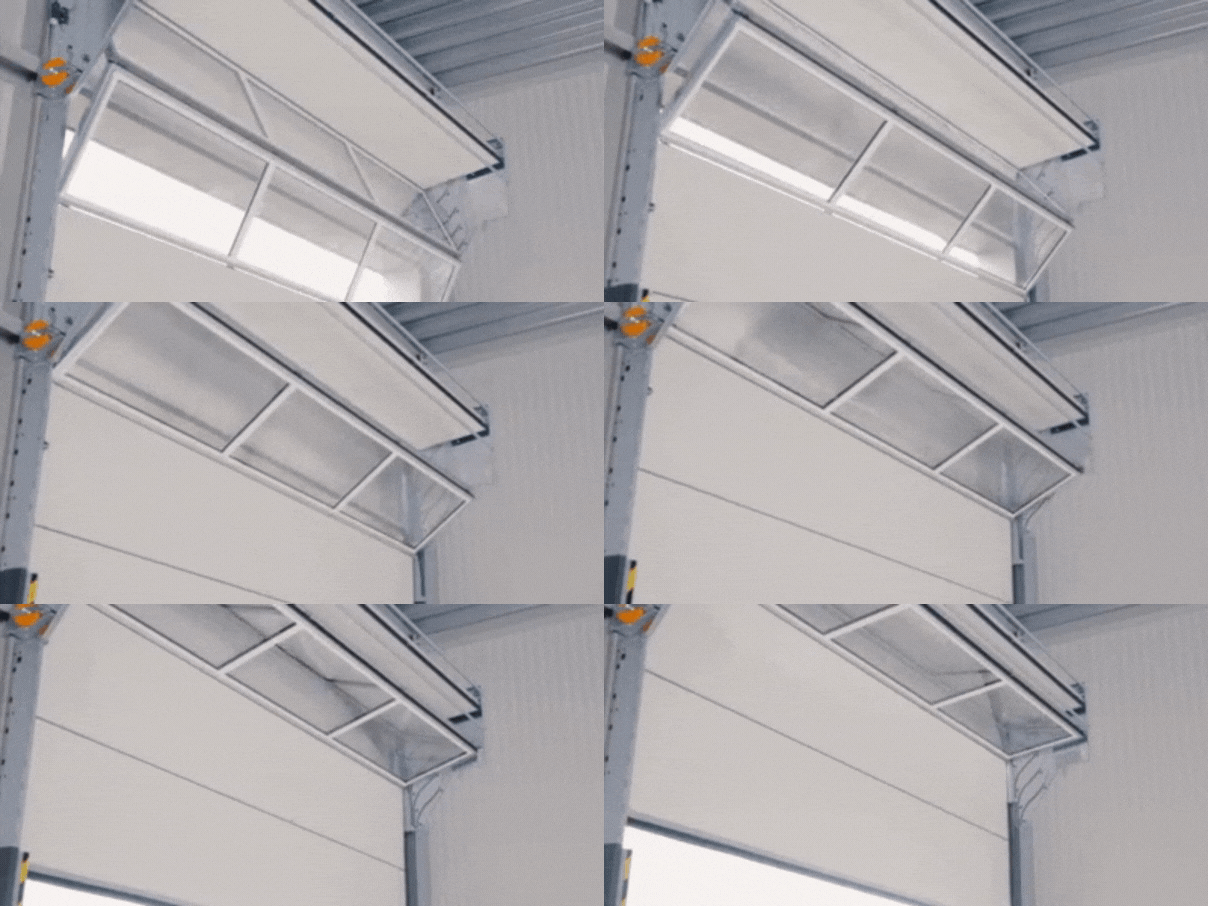
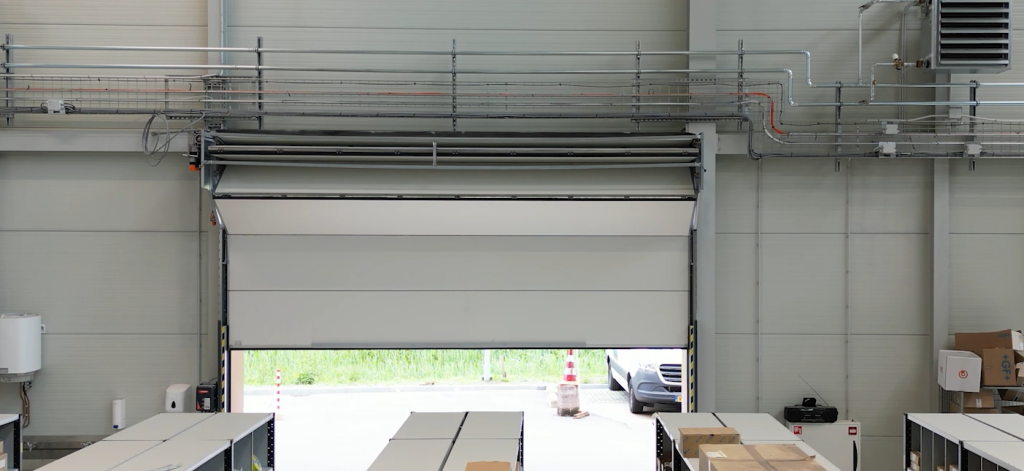
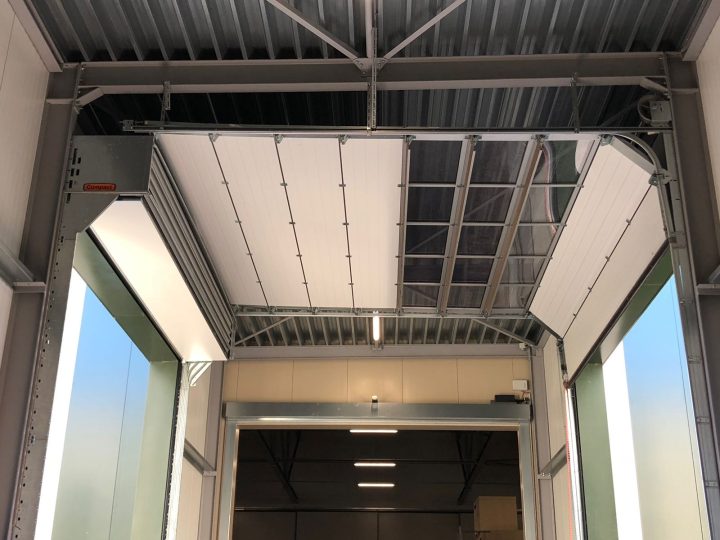
If you’re comparing sectional doors and roller doors, it’s worth considering a third option: the Compact door by The Compact folding door combines the advantages of roller doors and sectional doors in one smart, space-saving solution.
The door panels fold into a compact stack directly above the opening, similar to a roller door, but without the need for ceiling tracks. This keeps the ceiling completely free for lighting, ventilation, cranes, or other technical installations — a major advantage in industrial and commercial buildings with limited headroom.
Unlike traditional roller doors, the Compact door offers excellent thermal insulation and a high-quality appearance comparable to a sectional door. A wide range of panel finishes, colours, glazing options and configurations allows the door to be fully adapted to both functional and architectural requirements.
The Compact industrial door operates without torsion springs, eliminating a common wear component found in sectional doors. This results in lower maintenance requirements, increased reliability, and safer operation over the door’s lifetime.
Designed for intensive use, the Compact overhead door is TÜV-tested for up to 100,000 cycles, ensuring long-term performance in demanding environments. Its robust construction and smooth folding mechanism make it a dependable choice for daily operation.
The Compact folding door is the ideal solution for buildings where space efficiency, insulation, durability and design flexibility are equally important — without compromise.
So, are sectional doors more expensive than roller doors?
The answer depends on the type of roller door you compare.
- Basic roller doors may be cheaper upfront
- Insulated roller doors are often similar in price or even more expensive
- Sectional doors provide better insulation and more design flexibility
- Long-term maintenance and energy savings can make sectional doors the better investment
For many modern industrial buildings, solutions like the Compact door offer the most efficient balance between space-saving design, durability and performance.
Conclusion
So, are sectional doors more expensive than roller doors?
In terms of initial cost, sectional doors are sometimes slightly more expensive than basic roller shutters. But once insulation, durability, design options and long-term maintenance are considered, sectional doors often provide better overall value.
And if you want the compactness of a roller door with the insulation and aesthetics of a sectional door, the Compact door is a smart, future-proof alternative.